
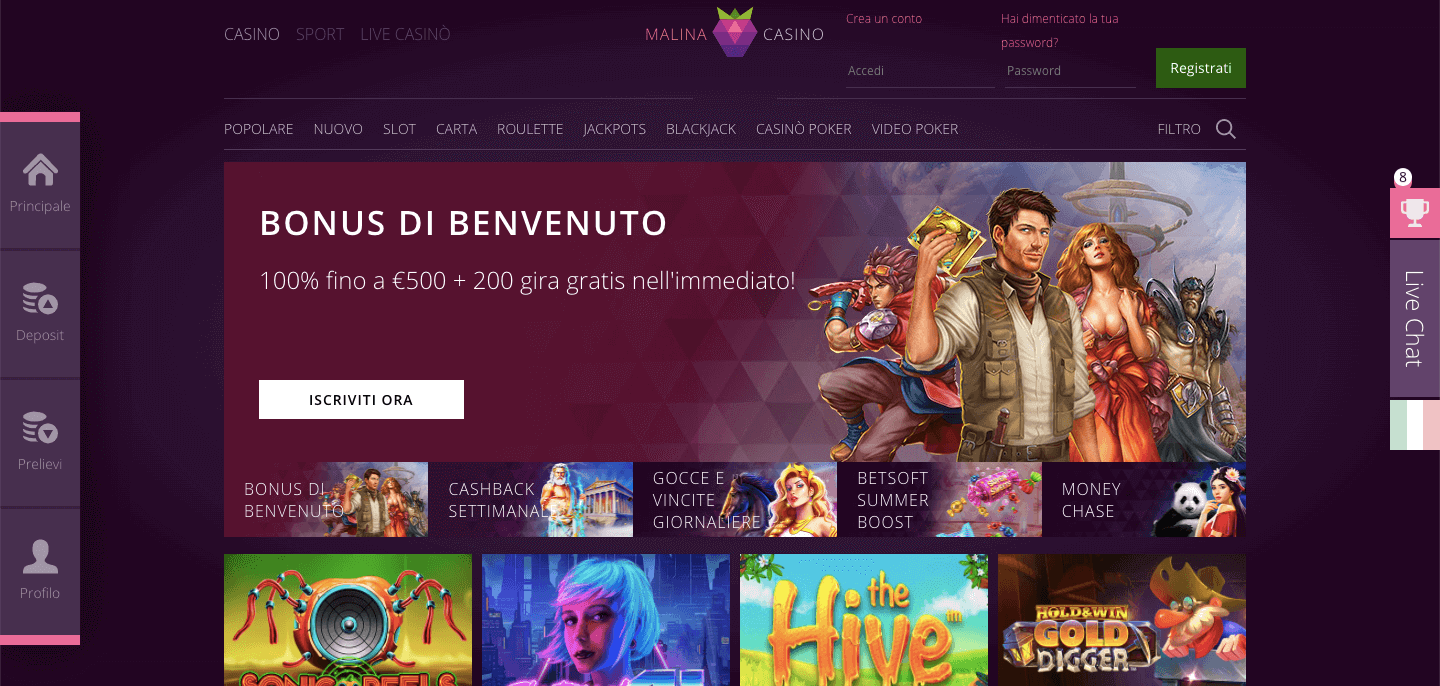
When a Canadian player first considers an online gaming platform, security of the account frequently registers as a quiet afterthought until the moment personal details are asked for malinascasino.org. Within Malina Casino, the initial encounter with its security infrastructure shows a carefully planned and multi-layered design that surpasses the usual email-and-password entry point. The registration flow itself immediately signals attentiveness to protective protocols without being burdensome. The form demands a strong password, mandates a unique username, and subtly educates the customer about the importance of credential hygiene via inline prompts. Once the account gets created, the platform gently nudges new members toward activating additional protective measures. What stands out most in the overall experience is how the casino has woven smooth safeguards into the daily user journey. The security framework feels neither aggressive nor permissive; it occupies a meticulously calibrated middle ground that values the player’s time while guarding sensitive data. This analytical overview will unpack each component of that framework, derived from a detailed, hands-on review of the set of tools a typical Canadian user encounters from sign-up through routine play, funding, and withdrawal processes.
Continuous Security Education and Assistance
Even the most sophisticated technical defenses depend on user awareness to be fully efficient, and Malina Casino invests in continuous security education that Canadian players will find both helpful and pleasantly free of clichés. The platform maintains a specific security resources section that addresses topics such as detecting phishing attempts, setting up a secure home network, and safely using public Wi-Fi when accessing the account. These articles are brief, updated regularly to reflect current threats, and written from the standpoint of a gamer rather than an IT professional, rendering the advice easy to absorb and use. When account-related support is needed, the live chat feature pairs the player with representatives who have clearly been trained in security protocols, accurately authenticating identity without falling for social engineering tricks and never requesting sensitive information like full passwords in plain text. Email communications from the casino consistently employ digital signatures and avoid inserting clickable links in a manner that could be forged, discreetly teaching the user to look for a high standard of correspondence. The security team also dispatches timely alerts about emerging threats, such as copycat apps and fraudulent mirror sites, reinforcing the message that official channels should always be employed. This holistic educational layer changes the player from a potential weak link into an active participant in the safeguarding of their own account. In the end, the combination of clear guidance, responsive support, and proactive threat awareness strengthens the sense that the casino views security as an ongoing partnership rather than a one-time setup.
Account Access Tracking and Session Controls
One of the most reassuring aspects of daily interaction with the platform is the ongoing surveillance of login activity and the complex session management tools placed directly in the user’s control. Every successful and unsuccessful authentication attempt is logged with a time stamp, device type, browser fingerprint, and an estimated geographical location derived from the IP address. This data is shown in a clear, easy-to-read log within the account security dashboard, letting a player to quickly detect an unfamiliar record from an strange location or device. If a suspect occurrence is detected, the system can automatically terminate all active sessions except the current one and trigger a password reset, a fast containment action that limits potential damage. The ability to see remotely and revoke specific sessions is a feature more commonly associated with enterprise platforms, and its inclusion here signals a serious investment in user-facing security controls. Additionally, the automatic logout timer, which can be modified in settings, protects idle sessions from being exploited on shared or public computers, a situation that remains applicable for players who may access their account from a library or internet café. Notifications for new device logins are issued promptly via email, providing an immediate alert should an unauthorized party gain entry. These session-layer defenses, alongside the persistent login audit trail, create an environment where the account holder is always informed about who has accessed their profile and from where, a openness that substantially reduces anxiety around digital security.
Sign-Up Process and Preliminary Security Measures
The initial interaction a visitor has with Malina Casino’s security strategy occurs during the account creation step, which reveals far more than a basic data collection interface. The platform mandates a password that meets specific complexity requirements, including uppercase letters, digits, and special characters, and it provides a real-time strength indicator that offers immediate response. This small feature transforms a mundane task into an educational opportunity, encouraging the user to avoid recycling weak credentials from other platforms. Once the email address is submitted, a time-sensitive verification link is forwarded, tying the account to a confirmed digital identity and preventing unauthorized registrations. Many platforms treat this step as optional, but here it is non-negotiable, a firm indicator of the operator’s security stance. The mobile responsiveness of the entire setup sequence also deserves acknowledgment, because a Canadian player using a smartphone will find the same rigorous validation steps without any truncation or workaround. After email approval, the interface presents an unobtrusive recommendation regarding two-factor verification, positioned not as a forced hurdle but as a recommended action with a brief overview of its perks. This thoughtful onboarding sequence means that within the first five minutes, the user has already been guided through multiple defensive stages without ever feeling overwhelmed. Such a methodical beginning builds immediate trust and sets the standard that security is integral to the interaction, not a peripheral matter addressed only when a problem occurs.
Credential Robustness and Management Policies
Beyond the establishment requirements, the platform’s continuing relationship with password management demonstrates a advanced understanding of how actual users operate and in which places common weak points emerge. Malina Casino periodically evaluates account credentials against known compromised password databases, a behind-the-scenes check that alerts the user if their picked passphrase has appeared in public data leaks. Instead of forcing a mandatory reset immediately, the security team offers the information clearly and recommends an update, which acknowledges the player’s autonomy while satisfying a duty of care. The password change interface by itself is protected by re-authentication, implying that even if a session token is hijacked, an attacker cannot alter the primary credential without first supplying the current password. Moreover, the platform enforces a reasonable minimum length rather than an arbitrary and frustrating rotation schedule that often results in weaker, pattern-based passwords. Canadian players who favor using a password manager will appreciate that the login fields do not actively block pasting or auto-fill functions, a common anti-pattern that inadvertently encourages short, manually typed secrets. The whole password ecosystem here is engineered to guide, educate, and protect rather than to impose rigid rules that push users toward workarounds. In a landscape where credential stuffing remains a ongoing threat, these policies exhibit a proactive and pragmatic stance that conforms to modern cybersecurity best practices while acknowledging that the human element is often the most significant variable in the security equation.
Fund Safeguarding Measures
Money transfers constitute the riskiest surface for any online casino account, and the withdrawal security architecture at Malina Casino has been designed with several validation checkpoints that thwart fraud without introducing excessive delays. A withdrawal request initiates an automated check that contrasts the target method against all previous deposit instruments, enforcing a closed-loop policy that stops funds from being diverted to an unassociated account. Any irregularity, such as a new e-wallet or bank card, triggers a mandatory re-verification step that validates ownership before the transaction can continue. Large withdrawal amounts above a configurable threshold activate an extra manual review by the security team, which checks recent activity logs and can get in touch via a pre-defined communication channel to authenticate the request’s validity. This might sound intrusive on paper, but in practice it functions quietly and rapidly, often completing within a timeframe that equals normal sector processing times. The platform also offers the elective freezing of withdrawal functions for specified periods, a feature that effectively neutralizes a key attack vector: an unauthorized party obtaining entry the account and attempting a fast cash-out to an anonymous destination. Email and push notifications are dispatched at every stage of the withdrawal process, producing a paper trail that maintains the rightful account holder informed in real time. The overall effect of these measures is a financial boundary that feels solid yet adaptable, making sure that transferring winnings out of the account is a safe event rather than a moment of vulnerability.
KYC Verification and KYC Procedure
The Know Your Customer journey at Malina Casino is among the most organized and clear systems a Canadian player is apt to find, and its design reveals a strong commitment to regulatory compliance without sacrificing user clarity. Upon hitting certain transactional thresholds, or from time to time as part of routine checks, the account enters a verification status that is explicitly communicated through both email and an on-site notification center. The mandatory documents are standard: a government-issued photo ID, a latest utility bill or bank statement displaying the registered address, and in some cases proof of ownership of the payment method used. The submission portal is coded and enables uploads straight through the browser, with real-time format validation that eliminates annoying rejections due to cut-off borders or unreadable expiry dates. What distinguishes the encounter is the speed and clarity of the review process. Status updates are relayed within hours instead of days, and any request for additional information comes with a plain-language explanation of specifically what is needed and why. Once confirmed, the account gains full transactional functionality, and the user’s account is marked with a verification badge that contributes an extra layer of internal security review. For high-value players or those initiating certain risk parameters, a quick video verification step may be implemented, which brings a powerful anti-fraud element while keeping respectful and professionally conducted. This thorough yet efficient KYC framework ensures that the gaming atmosphere remains safe for all players, stopping impersonation and underage access with minimal hindrance for legitimate users.
Encryption of Data and Privacy Safeguards
Underlying every action with the Malina Casino interface lies a robust encryption architecture that initiates with the mandatory use of TLS 1.3 across all pages, not only during financial transactions. This ensures that all data transferred between the player’s application and the casino’s servers remains unreadable to any intermediary, a fundamental protection that many platforms compromise by using encryption selectively. The platform’s privacy policy, written in plain language that avoids legal obfuscation, clearly states that personal information is kept on servers situated in jurisdictions with robust data protection laws, and it outlines exactly which data points are captured and for what practical purpose. Canadian privacy-conscious users will value that the casino does not conduct opaque data-sharing practices with third-party marketing aggregators without specific, granular consent acquired through an opt-in mechanism as opposed to a pre-checked box. The site’s stance regarding cookies is just as transparent, with a preference center that enables the user to refuse non-essential tracking without diminishing the core gaming experience. Furthermore, the internal management of sensitive documents like ID uploads is governed by automated purging policies, implying that once verification is complete, the raw files are securely deleted from active storage and kept only in a strongly encrypted archival format for the minimum duration required by law. This consideration to the full data lifecycle, from transfer to retention to removal, establishes a firm foundation of trust and underscores a privacy mindset that exceeds surface-level compliance.
2FA Implementation
2FA at Malina Casino is neither a gimmick nor a obscure setting tucked away within account settings, but a clearly presented shield that any safety-minded Canadian player should turn on without delay. The platform supports time-based one-time passwords generated through standard authenticator applications, which is much superior to SMS-based codes vulnerable to SIM-swapping attacks. Setting up the second factor is a smooth process: a QR code displays on screen, the user scans it with an app like Google Authenticator or Authy, and a six-digit code validates the link. Once enabled, every login attempt from an unfamiliar device or browser initiates the additional code requirement, effectively cutting off any attacker who may have acquired the password through phishing or data breaches elsewhere. The system cleverly remembers trusted devices for a configurable period, finding a thoughtful balance between stringent protection and everyday convenience, so the user does not need to grab the phone upon every single session from a home desktop. Recovery options are equally well-considered; instead of using insecure SMS fallback, the platform offers a set of single-use backup codes during initial setup, with clear instructions to store them offline. Should a player lose access to the authenticator app, a safe support-led recovery protocol involving identity verification can recover access, though the intentional difficulty in that process is itself a safeguarding feature. Noticing how smoothly the 2FA mechanism blends into the login flow confirms that Malina Casino considers this as a cornerstone of account integrity, not an secondary concern.
Secure Wagering Security Tools
Account security is not entirely distinct from the protective features focused on guaranteeing responsible gambling, and at Malina Casino these two areas are treated as complementary pillars of a single user protection strategy. The self-imposed limit tools available include deposit caps, loss thresholds, wager limits, and session time reminders, all of which are adjustable directly from the account dashboard and become active immediately. What raises these tools into the realm of genuine security is their resistance to impulsive overrides; cooling-off periods can be activated, and self-exclusion requests require a careful, multi-step process with a mandatory waiting period before any reversal, effectively blocking the ability to undo protective barriers in a moment of distress. The integration of reality checks, which pause gameplay at user-defined intervals to display session statistics, acts as a awareness trigger that helps maintain awareness and control. For players who need stronger intervention, direct links to Canadian problem gambling support organizations and a comprehensive self-exclusion program that spans the operator’s entire network are easily accessible, prominently positioned rather than buried in fine print. These tools together defend against the security risks that arise from impaired decision-making, such as overspending or sharing login details with unverified third-party services promising recovery of losses. By embedding responsible gambling mechanisms tightly into the account management framework, the platform acknowledges that protecting a user’s financial and mental well-being is as critical as defending against external bad actors.